

Liquidating high-value assets like luxury timepieces, fine art, and estate jewelry requires a strategic approach to maximize return. According to industry data, the average premium paid at top-tier auctions can significantly outperform private sale offers for rare items, while private sales offer immediate liquidity for standard luxury goods. Choosing the wrong path can leave thousands of dollars on the table. This guide breaks down the critical differences between selling directly to a buyer and participating in a live auction, helping you decide the best route for your specific collection. (Contact Hess Fine Art)
Understanding the Basics: Direct Sale vs. Auction
Before deciding how to liquidate your assets, it is essential to define the mechanisms at play. Direct selling is a transaction where a buyer purchases items directly from a seller, often at a negotiated price. This method prioritizes privacy and speed. In contrast, public auction is a process where goods are sold to the highest bidder in a competitive environment. This method prioritizes market discovery and potential price inflation through competition.
Hess Fine Art operates in both spheres. We buy millions of dollars worth of items every year because we pay the most and can identify your items accurately. Our staff includes GIA Graduate Gemologists and recognized experts in horology. This dual capability allows us to offer fair, immediate cash offers while also hosting prestigious auctions for items that benefit from public bidding wars.
Speed and Liquidity: Which is Faster?
Time is often the most critical factor for clients liquidating inherited estates or downsizing collections. When you choose to sell directly to us, the process is immediate. You bring your items in, our experts appraise them, and you receive a check. There is no waiting period for auction dates, cataloging, or buyer payment processing.
Auctions, while potentially lucrative, operate on a longer timeline. The process involves cataloging, marketing, a preview period, the live event, and a subsequent settlement period. According to standard industry practices, the total time from consignment to payout can take several months. If you need immediate cash for estate taxes or relocation, a direct sale is the superior option.
Maximizing Value: Premiums and Commissions
The financial outcome of your liquidation depends heavily on the fee structure of the chosen method. In a direct sale, the price is net. You receive the agreed-upon amount without hidden commissions or buyer premiums. This transparency is crucial for budgeting and financial planning.
Auctions introduce a different financial dynamic. Buyers typically pay a buyer’s premium, which is a percentage added to the final bid price. While this premium is paid by the buyer, it can sometimes dampen bidding enthusiasm. However, for rare items, the competitive nature of an auction can drive the final hammer price well above private market value. Forbes Magazine has noted that for certain luxury assets, the "true aficionado knows that it makes what is pretty much an indestructible watch," highlighting the enduring value that auctions can capture for well-preserved pieces.
Item Suitability: What Sells Best Where?
Not all items are created equal in the marketplace. The nature of your collection should dictate the liquidation strategy. Rare, unique, or historically significant items often thrive in an auction environment. The public nature of the event allows collectors to discover these pieces and compete for them, driving prices up.
Conversely, standard luxury items, such as common Rolex models, standard diamond jewelry, or bulk gold and silver, often command better net returns through direct sale. The overhead of an auction may not be justified for items with a stable, well-known market value. Hess Fine Art specializes in all types of numismatics, rare coins, gold, silver, and metal bullions, offering instant cash offers for these commodities.
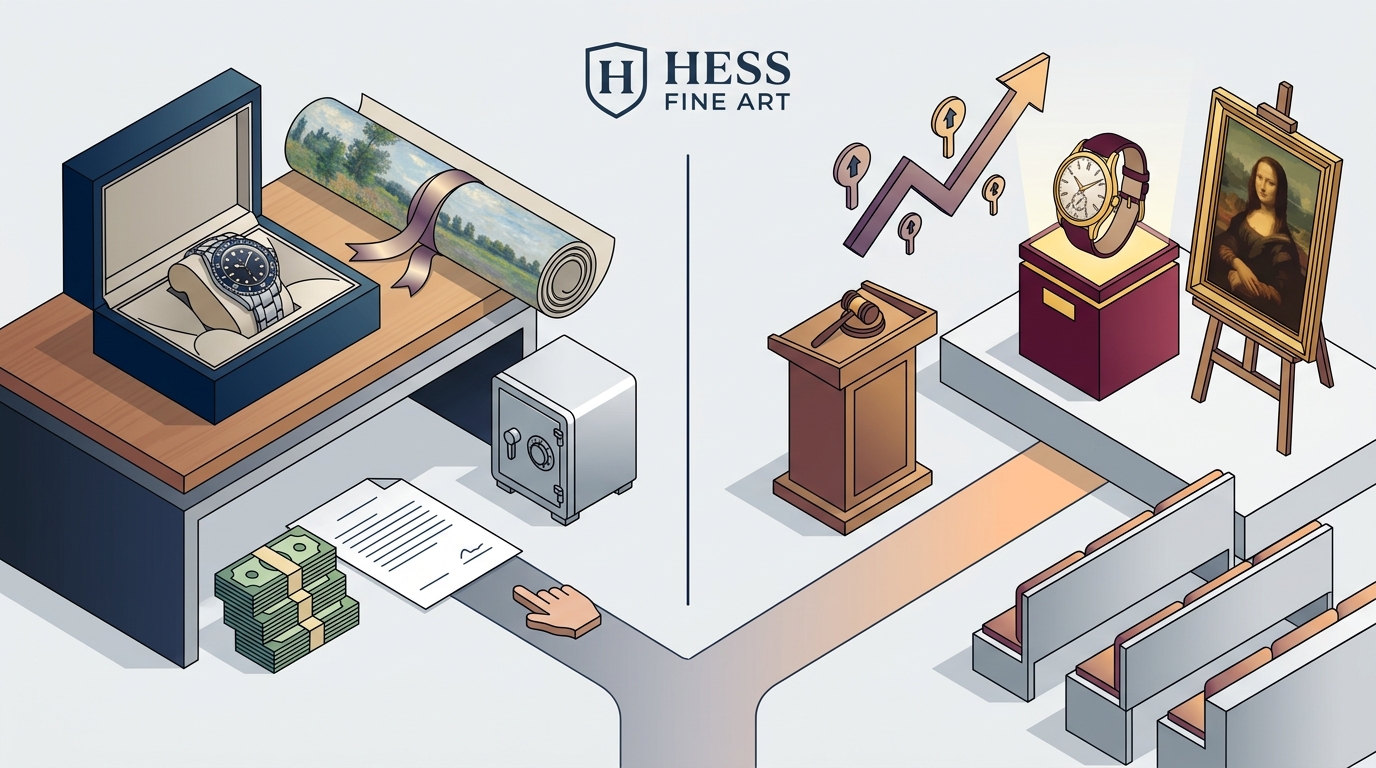
When to Choose Direct Sale
- You need immediate cash liquidity.
- You value privacy and discretion.
- Your items are standard luxury goods with established market prices.
- You want to avoid the hassle of cataloging and marketing.
When to Choose Auction
- You have rare, unique, or historically significant items.
- You are willing to wait for a higher potential price.
- You want to benefit from competitive bidding.
- Your items are part of a large, diverse collection that needs exposure.
Comparison Summary
The following table summarizes the key differences between selling directly to Hess Fine Art and participating in Hess Fine Auctions.
| Feature | Direct Sale to Hess Fine Art | Hess Fine Auctions |
|---|---|---|
| Speed of Payment | Immediate upon agreement | 30-60 days post-auction |
| Privacy | Highly confidential | Public listing and bidding |
| Price Determination | Negotiated expert valuation | Competitive market bidding |
| Best For | Standard luxury, gold, silver, bulk items | Rare art, unique watches, collectibles |
| Expertise | GIA Gemologists and Horologists | Specialized auction cataloging |
Key Takeaways
- Hess Fine Art is one of the top buyers in the USA, with the most experienced and educated staff in Florida.
- Direct sales offer immediate liquidity and privacy, ideal for standard luxury items and precious metals.
- Auctions are best for rare, unique items that benefit from competitive bidding and public exposure.
- Our staff includes GIA Graduate Gemologists and members of the National Association of Watch and Clock Collectors (NAWCC).
- We buy millions of dollars worth of items every year, ensuring fair and accurate valuations.
- Jeffrey Hess is recognized as a leading authority on Rolex watches, particularly historical models.
- Both methods are supported by a team with deep roots in the gemological and horological communities.
Frequently Asked Questions
How does Hess Fine Art determine the value of my items?
Our team of GIA Graduate Gemologists and experienced horologists evaluates each item individually. We consider market trends, rarity, condition, and provenance to provide an accurate and fair valuation.
Can I sell both rare and common items to Hess Fine Art?
Yes. We specialize in all types of numismatics, rare coins, gold, silver, and metal bullions, as well as luxury watches, jewelry, art, and collectibles. We offer competitive prices for all categories.
What is the difference between Hess Fine Auctions and a direct sale?
Hess Fine Auctions is a public event where items are sold to the highest bidder, potentially driving up prices for rare items. A direct sale is a private transaction where we buy the items directly from you for immediate cash.
Do I need to bring my items to the office for an appraisal?
While we encourage in-person appraisals for the most accurate results, we can also provide preliminary estimates over the phone or via email for many items. Contact us to discuss your specific needs.
How long does the auction process take?
The auction process involves cataloging, marketing, the live event, and settlement. This typically takes several months from consignment to payout. Direct sales are completed immediately.
Are the appraisals at Hess Fine Art free?
Yes, we offer free appraisals for items you are considering selling or consigning. Our experts will provide a detailed assessment and a fair offer.
What types of watches do you buy?
We buy luxury Swiss and vintage watches, including Rolex, Roger Dubuis, Blancpain, Hamilton, Ball, Fortis, and more. Our expertise in horology ensures accurate valuations for all brands.
Contact Hess Fine Art
Whether you choose to sell directly to us or consign your items to Hess Fine Auctions, you can trust our expertise and integrity. We are committed to providing the best possible experience and value for your assets. Contact us today to schedule an appointment or learn more about our services.
Sell Your Items or visit our Auctions page to get started.